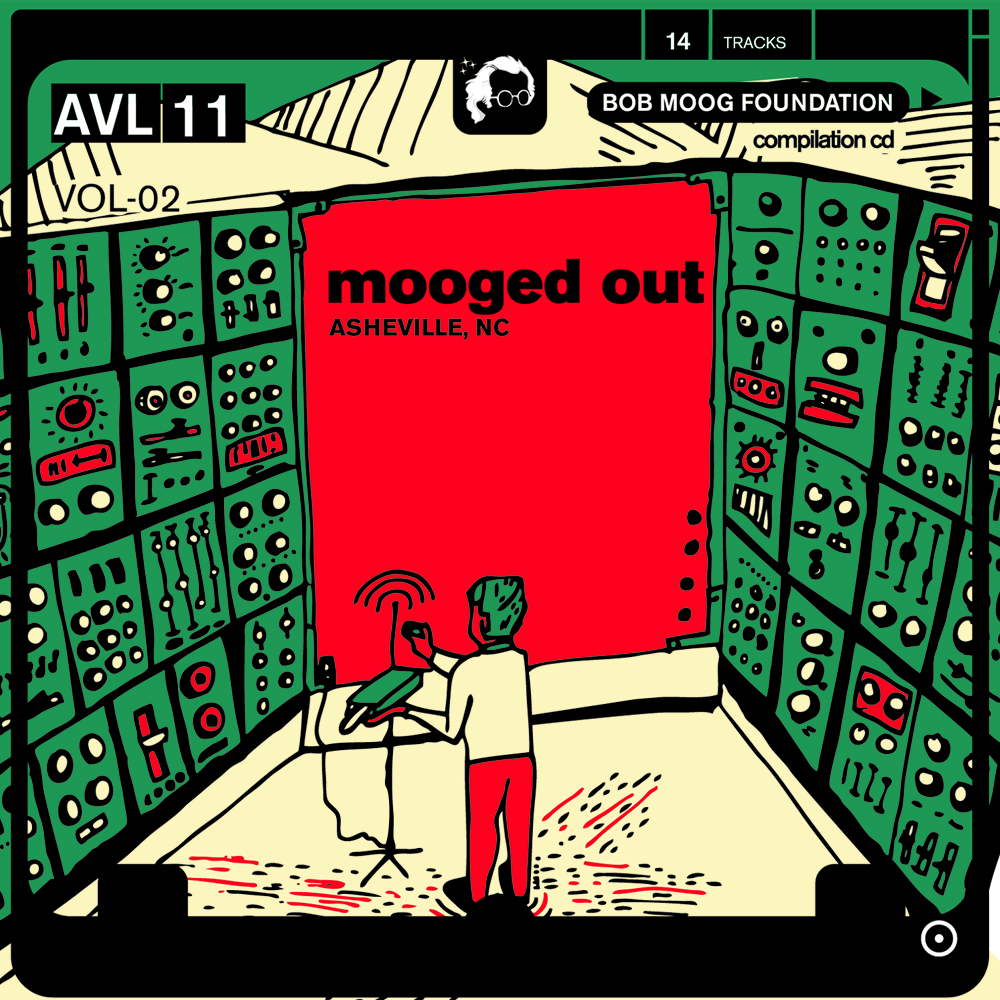

Mooged Out Volume 2: Highlights and Studio Notes

Mooged Out Asheville, Volume 2 features 14 Asheville-based recording artists, each contributing a track to benefit the Bob Moog Foundation. Spanning musical styles ranging from rock and hip-hop to dubstep and avant electronica, the album is a dynamic showcase for the wealth of sounds inspired by Bob Moog’s contributions to modern music. The album is not strictly electronic music, but an expression of the wider pool of creativity that Bob touched.
Compiled and produced by BMF volunteer Dave Hamilton, who also produced the first volume, the CD is dedicated to Meg Lauzon, who was a friend to the Foundation and to the Asheville music community. The opening track features BMF Executive Director Michelle Moog-Koussa reading a description of Bob’s one-of-a-kind invention, the Multiple-Touch-Sensitive Keyboard, accompanied by music from the duo Blinding Standstill. Additional tracks were contributed by the West African-influenced Toubab Krewe (one of Bob’s favorite bands), as well as acts such as Stephaniesid, Telepath, and 15-year-old phenom Summit Jaffe, also known as Numatik.
Mastering for the album was contributed by Seva at Soundcurrent Mastering, Knoxville, TN.
Purchase the album in our online store
You can hear samples from individual tracks by clicking the links to iTunes below.
Tired – Eymarel
“Eymarel feels extremely grateful and privileged to be part of the mission to spread Bog Moog’s legacy. Together we can continue to explore and spread the power of electronic sound and music. We take pride in creating music and expressing emotion with some of the best gear on the market designed by one of the greatest synthesizer pioneers — Bob MOOG!”
- Mary Frances and Lee Allen, Eymarel
Song Unsung – Blinding Standstill [Feat. Michelle Moog-Koussa]
Inspired by the innovations of Bob Moog and the memory of Meg Lauzon, this track features Bob Moog Foundation Executive Director Michelle Moog-Koussa’s musical debut. Michelle is reading from Bob’s description of the Multiple Touch Sensitive Keyboard, a project that was of great importance to Bob but is not as widely known as his other inventions. The numbers she is reading are the patents for the keyboard. This track was also featured in our video highlighting the MoogLab interactive program.
Outta My Head – Jeff Knorr and the AVL Soul Orchestra
Jeff Knorr – Moog Voyager (Bass and Lead)
Lee Allen – Drums
Mary Frances – Electric Piano
Derrick Johnston– Trombone
Ben Hovey – Trumpet, Moog Voyager
Jason Daniello – Moog Guitar
Track notes from Dave Hamilton, producer:
Jeff Knorr is a multi-talented keyboard player, the owner of CollapseAble Studios, and the composer of “Outta My Head.” He is also a dynamic collaborator who was happy to assemble an all star funk band of Asheville musicians to record a track live at the Orange Peel as part of the entertainment for Bob Moog’s 75th Birthday celebration on May 21, 2009. A unique aspect of this live recording was that the band members were not all playing together on stage at the same time. They each took turns recording their parts in layers to help demonstrate the effects of Moog gear on song structure.
After the initial tracking was complete, I took the song to Echo Mountain Recording Studio to treat it with Moogerfooger filter, phaser, and delay before the final mixdown.
Raindancer – Chalwa
Chalwa is an Asheville based reggae band whose track blurs the lines between rock and reggae with a distinctly Mooged-out sound.

Amends – Jar-E
“The freedom and creativity that flows from a session using Moog equipment is unparalleled. I am glad for the opportunity to be a small part of the legacy left by such a gifted and giving man as Bob Moog.”
-John Reid, Jar-E
Holy Grail – Toubab Krewe
Track notes from Dave Hamilton, producer:
Toubab Krewe has a special connection to the Bob Moog legacy. In the early part of their career, their debut CD was given to Bob when he was near the end of his life. He found himself listening to it late one evening while being kept awake by his medical treatments. The impressive musicianship of the West African-influenced dance music energized and inspired him.
When Toubab Krewe entered Echo Mountain Recording Studio to record their second work (TK2), the Bob Moog Foundation loaned the band an assortment of Moog gear to use in the recording. They found themselves pushing sonic boundaries and feeling inspired as a result. “Holy Grail” is one of the songs resulting from this experimentation.
Freedom – Telepath [feat. Williamtell]
Keyboardist/producer Michael Christie brings an arsenal of samples—horn lines, rhythm guitars, Indian and Arabic musicians and vocalists – and lays them over deep groove drumming and dark, reggae-infused basslines. The result is a multi-layered journey of sound that can transport listeners from a remote village in Pakistan, to a dub studio in 1970s Jamaica, to a fat Philly hip-hop groove. His track for Mooged Out Volume 2 combines many of these elements and features a soulful vocal track.
Wonderworld (feat. Sidney Barnes) – The Secret B-Sides
“Bob Moog opened the way for electronic music technologies to reach everyday people. The Bob Moog Foundation continues his work by expanding greater access to the future tools of human expression.”
-Juan Holladay, the Secret B-Sides
Me and Dog – Stephaniesid
National touring artist Stephanie Morgan added her characteristic charm to MOv2 with her track, “Me and Dog.” The song starts off sweetly and builds to a dynamic climax.
Bring the Walls – The Adapters
Mike Rhodes – Drums
Jay Sanders – Bass
Jon Paul Hess – Electric Piano
Chris Tanfield – Rhythm Guitar and Theremin
Jason Daniello – Moog Guitar
Molly Kummerle – Lead Vocals
Track notes from Dave Hamilton, producer:
The Adapters is the name associated with collaborative efforts between Molly Kummerle and myself for the benefit of the Bob Moog Foundation. The musical group draws from a rotating cast of Foundation volunteers. “Bring the Walls” was composed as a group effort by Dave, Molly, thereminist Chris Tanfield, and songwriter Joe Szabo. It was the first of four songs recorded live at Bob Moog’s 75th birthday celebration on May 21, 2009.
After equipping the Orange Peel’s stage with a portable recording rig, the evening began with Mike and Jay laying down a slow and solid rhythm track. Following their exit from the stage, Jon Paul sat down at the Wurlitzer electric piano while Chris plugged in his electric guitar to lay down the song’s melodic framework. The recording rig captured their performances as the recently finished rhythm track played through the house sound system. This live overdubbing process was then repeated for the theremin and Moog Guitar until the musicians had constructed a full instrumental track. As the celebration continued, Molly stepped onto the stage to record lyrics inspired by The Adapters’ mutual respect for Bob Moog’s work.
After the event, the tracks were taken to Echo Mountain Recording Studio for vocal overdubs, Moogerfooger application, and final mixing.
Sugar Mama – Josh Blake’s Jukebox
Their track, “Turn it Around” was a popular addition to Mooged Out Volume 1, and Josh Blake’s Jukebox is back on Volume 2 with an upbeat and soulful tune that is sure to get you groovin’. They are composed of some of Asheville’s finest musicians. The drummer Patrick Thomas and guitarist Casey Cramer are from the funky Asheville powerhouse Strut, Casey also plays guitar for the Josh Phillips Folk Festival. The Jukebox also features Kyle Colclasure on bass from the local hip hop band GFE. Affectionately dubbed “The Hot Sauce” female vocalist Marisa Albert spices up the show with beautiful harmonies. Keyboardist Justin Powell from Vertigo Jazz Project has been known to join in on the fun. Multi-instrumemtalist, Matt Williams of Matt Williams and The Ocean adds to the diverse sound of the Jukebox.
Dawn – Numatik
15 year old Summit Jaffe started playing with Moogerfoogers while most of his classmates were still hanging out on the playground. He made a splash at TEDx Next Generation Asheville with a dynamic performance that left everyone talking. On Mooged Out Volume 2 he uses creative application of Moog technology to generate a track that will keep you grooving.

Sous le Soleil – Afromotive 
“Most musicians have known for years how important Bob Moog’s work is in the music industry. I’m thankful that the BMF is helping to share that with the rest of the world, and that it’s based here in Asheville, NC!”
-Ryan Reardon, Afromotive
Chains of Love – Kellin Watson
Consistently named as one of the best performing artists in WNC, Kellin’s track on Mooged Out Volume 2 has a fantastic, funky, groove that will hook you from the first note. Check out this video of Kellin on Studio South shot by Meg Lauzon.
For Mooged Out Volume 2, Chains of Love was remixed by Aaron Price and Seva David Ball in Studio P, Knoxville, using a Moog Voyager and a pile of MoogerFooger boxes. Unique beat-mapping and triggering were used to sync processing of many tracks, including a perfectly good Steinway, which underwent the MoogerFoogerization process, nonetheless. There are rumors a surround version is in the can.
What is That Thing and Where Can I Get One?
August 21, 2010 – Fifth Anniversary Tribute
Seva David Ball, Preservationist on BMF GRAMMY Grant Reflects on Bob’s Impact on His Life
My introduction to the Moog was at Christmas 1968, of course through Switched-On Bach by Carlos. I thought, what is that organ record sounding thing, then when I wandered into the stereo room, finding the record jacket was an Acme Anvil moment. I didn’t even remove the shrinkwrap from the record because I didn’t want the picture to get dirty. Occasionally I’d sneak my fingers under the cellophane and touch the Picture of the Moog.
No kidding.

Seva David Ball, Age 12, Florida State University, 1968 (courtesy Seva Ball
My parents taught college and a colleague of theirs was an alumnus of Florida State. She foolishly offered to take me with her because they had a Moog IIIp. The die was cast, I turned into fluid, poured into the mold, then the mold was broken. The accompanying picture illustrates this moment of pre-hormonal ability of focus, sans prefrontal cortex development, where an experience is so indigenously saturating that after I exited the building, the feeling was as if I’d traveled with Dr. Who and really had no idea what planet or timeline I was entering. That’s what the Moog did for me, what Bob Moog did for me in this unleashing of Pandora with absolute value. It’s all a plus sign.
Soon I had built my studio, replete with a IIIp, MiniMoog, and a PolyMoog, and drilled down into the soft surreal forms I’d heard in my head; now able to realize them. Vintage Moog, classical training, surrealistic music dreams: finally. Search iTunes if you want to find out what happened.
At some point I wrote to Bob Moog and asked if he had any room for my skills in his business in North Carolina; this was before the rebirth of Moog Music, and he simply replied “we have no need for someone with your skillset at this time”. It was the most wonderful rejection letter ever, and certainly the only one I have framed. Now, I sit every day with tapes of Bob Moog and witness small splintered fractal subsets of audio, windows into that time as he was building, creating, innovating, his Moog Synthesizer. I remain as grateful as any human is capable of feeling, to him, Bob Moog, for giving me tools which set me free, musically, beyond my wildest imaginings.
Seva
August 2010
Keep an eye out for Seva’s upcoming post on some of the 40+ tapes that he has been restoring this summer.
Click here to see more about Seva’s work with the reel-to-reel tapes from Bob’s Archive.
Seva Explores the Abominatron Tape, part 2
Seva David Ball is the the preservationist for the restoration of 40 reel-to-reel tapes in Bob’s archives, a project which is generously funded by two grants from the GRAMMY Foundation. Seva is an audio engineer whose accomplishments include serving as associate founder of Waves, mastering Dolly Parton’s only live DVD, and being the preservationist on David Lewiston’s archives of over 650 tapes for the Library of Congress. He is the owner of Soundcurrent Mastering in Knoxville,TN. As he restores the tapes, Seva will be blogging a bit about each one, and including sound samples.
While the GRAMMY Foundation provides generous funding, they do not cover all of the costs associated with the extensive project. If you are inspired by historical material that we are preserving, please consider making a donation to the Foundation to help us continue our efforts.
In this blog post, Seva explores a tape that was donated to us by pioneering synthesist Herb Deutsch, who collaborated with Bob on the first prototype modular. In this 84 minute tape, Bob methodically explains the functions of the modular. We are excited to include five snippets of that tape here. Many thanks to Herb Deutsch for this historical treasure.
Abominatron Tape Transfer, Part 2
Seva David Ball
As alluded to in my first entry, when Dr. Moog was working on the prototype modular synthesizer in the early sixties, he had set in motion a very large number of design parameters, terminologies, and infrastructures. Things such as using ‘feet’ as designation for which pitch range within the oscillator would work, just as in pipe organs, i.e. 32′, 16′, 8′, 4′, 2′, 1′, all measured in feet to indicate the base length of the pipe in that rank. A pipe half the length of another gives a tone one octave higher (and twice the frequency, being inversely proportioned). Another example now in widespread use is “Voltage Control”, which was probably the most impressive part of the vocabulary to me (when I learned of it, I was 12) because it literally took the place of my hand turning a knob. Even with my limited understanding, this principle of voltage control was a cloudless sky for me; it unlocked the entire potential. The synthesizer had three main components: Sources, Controllers, and Modifiers, and voltage control made it all work.
On this tape, Bob explains that the voltages add together to control the oscillator, plus an internal voltage (selected by the Pitch Range switch=32, 16, 8, 4, etc) adds or subtracts eight-tenths of a volt, shifting the pitch up or down one octave. (Eventually there was a standard of 1volt/1octave but I will not pretend to know the precise evolution of this standard). He gives several examples of using low frequency oscillators (LFO) to provide (musical) vibrato and other forms of exotic vibrato (Frequency Modulation can yield classic space sounds or really new klang with mirrored sum-and-difference tones).
Voltage Control had already been part of Bob’s breadboard projects and his 1964 prototype. It was only a matter of months before others requested new ways for Voltage Control to be utilized. Vladimir Ussachevsky asked for a device to create an attack-decay-sustain-release voltage (ADSR) which was used to control an amplifier (VCA) so that pressing a note would create a tone with dynamic shaping. Gustav Ciamaga ordered a voltage controlled filter (VCF) in 1965, and this created the tone shaping everyone refers to as that Moog Sound (especially with Bob’s 4-pole filter design).
Bob took piano for many years as a young person, and could readily play, although he was very modest about his ability. He made a nearly innocent statement that others with more musicianship could get “some good things” out of the instrument, and I included a clip of this sincerely prophetic statement.
Better Musicianship:
Audio clip: Adobe Flash Player (version 9 or above) is required to play this audio clip. Download the latest version here. You also need to have JavaScript enabled in your browser.
In this proto-incarnation of the modular synthesizer — the Abominatron, as Bob called it — there were two VC devices: oscillators and amplifiers. (There’s a clip where he Gives It The Name, at least on tape). The astonishing part of all this to me remains the fact that this first modular synthesizer, this Abominatron, was POLYPHONIC. I’ve attached some audio clips from this tape, including the Intro Fanfare, where Bob plays a polyphonic greeting before he speaks, followed by a clip where Bob names the prototype.
Polyphonic Fanfare:
Audio clip: Adobe Flash Player (version 9 or above) is required to play this audio clip. Download the latest version here. You also need to have JavaScript enabled in your browser.
Abominatron
Audio clip: Adobe Flash Player (version 9 or above) is required to play this audio clip. Download the latest version here. You also need to have JavaScript enabled in your browser.
Another polyphonic section is when he first demonstrated voltage control for simple vibrato, but he plays a polyphonic example, “As I Walked Out in the Streets of Laredo”, in a two-part invention style, quite removed from Marty Robbin’s 1959 dreamy single. To my knowledge this song (and the Intro Fanfare) is the first recording of a polyphonic modular synthesizer. It is so beautiful that the inventor of the instrument is also a musician, and one who could play at the drop of a hat, and that we have this document, this recording, of Dr. Moog doing exactly that.
Modulate and Polyphonic:
Audio clip: Adobe Flash Player (version 9 or above) is required to play this audio clip. Download the latest version here. You also need to have JavaScript enabled in your browser.
A great thing about “audio letters” is you can stop recording any time and continue when convenient. Most of the time a click or pop signifies such a break, and in one such place Bob says “it’s 2 days later now” since his previous recording, and he reveals the spectacular news that Jacqueline Harvey of the AES (Audio Engineering Society) had called to invite him to have a booth at the October 1964 AES meeting in the Commercial Exhibits area (which at that time was hardly the large tradeshow floor familiar today; the main purpose of the meeting was for presentation of papers and so forth). There’s an audio clip where he reveals this news to Herb Deutsch, and went on to say that it was a “tremendous opportunity for me to get this going, sooner than I thought”, but he also recognized being at the AES show had the potential for him to makethat it was also a “an a– of myself”. That didn’t happen. The opportunity for success immediately began to realize itself. Clearly, we all know he succeeded beyond his expectations and would initiate a paradigm shift in the use of electronics in music as instruments.
AES Invite:
Audio clip: Adobe Flash Player (version 9 or above) is required to play this audio clip. Download the latest version here. You also need to have JavaScript enabled in your browser.
Seva Reports on Transferring the “Abominatron” Tape
Introduction: Seva David Ball is the the preservationist for the restoration of 40 reel-to-reel tapes in Bob’s archives, a project which is generously funded by two grants from the GRAMMY Foundation. Seva is an audio engineer whose accomplishments include serving as associate founder of Waves, mastering Dolly Parton’s only live DVD, and being the preservationist on David Lewiston’s archives of over 650 tapes for the Library of Congress. He is the owner of Soundcurrent Mastering in Knoxville,TN.
The tapes in the Bob’s archive span the years of 1964-1983, with work by pioneering synthesists such as Herb Deutsch, JonWeiss, Chris Swanson, Emmanuel Ghent, Wendy Carlos, Isao Tomita, Roger Powell, Joel Chadabe, John Eaton, William Hoskins, LaMonte Young and many more. Perhaps no tape in the collection is more seminal than the tape that Herb Deutsch donated to the Bob Moog Foundation in August. This 84 minute recording, which we here at the Bob Moog Foundation affectionately refer to as the “Abominatron” (as that is how Bob refers to the prototype modular), was recorded in 1964 in preparation for sending the prototype to experimental jazz musician Herb Deutsch. Herb, a professor of music (then and now!) at Hofstra University, collaborated with Bob for a year prior, giving him ideas, direction and input on a new instrument that they would call the “Electronic Music Composition System” — later to become known as the Moog synthesizer.
In the summer of 1964, Herb spent three weeks working side by side with Bob in his basement workshop in Trumansburg, New York, where Bob lived and was ran R.A. Moog, Co. Herb was to be Bob’s first musician-muse, and that first instrument was built largely to Herb’s specifications. Bob spent a couple of months perfecting the prototype and in the fall of 1964, prepared it to send to Herb. Along with the instrument, Bob sent a tape thoroughly explaining the various controls, perameters and capabilities of the instrument.
It is with deepest gratitude that we thank Herb for sharing the tape with us, and for allowing us to share it with you. By the end of 2010, we hope to produce a CD of the tape to share with all of you. We will be working on that project in the coming months.
From Seva:
This tape is logged as number 000, as it is really the very first chronological tape in the collection, and computer people (myself) start counting with zero! There’s another practical reason here: I’d already begun assigning tape numbers when Herb Deutsch graciously made this tape available to the Bob Moog Foundation, and since it is directly related to the pre-history of the commercial modular synth, I assigned it catalog number 000.
To set a frame of reference: I played my first Moog synthesizer at the age of 12 in 1970. It was a huge IIIp with dual sequencer complement at Florida State University (John Boda was the primary guy there) and I learned that the Moog was essentially a monophonic instrument (one note at a time). Last month I listened to the tape that Bob Moog made in 1964 as an audio letter to accompany his prototype synthesizer, which was being sent to Herb Deutsch. I was slack-jawed when I listened to the tape as Bob explained about the controls on the prototype device, and then played polyphonic sounds on this modular Moog synthesizer! This was 1964! I really couldn’t believe it, that this early prototype for the modular synthesizer was actually polyphonic. To my knowledge, this has not been revealed in any historical book on electronic music, the development of the modular synthesizer, or even as an anecdotal story told by those who were there. Absolutely amazing!
Listening to Bob talk about the controls on the prototype modular gave me a very clear insight on exactly how precedent is set. Bob would talk about the Range control, the Voltage control patch, the octaves as 8′, 4′, 2′, etc.: terms which are used on synthesizers to this very day, on Moog synthesizers made in this very year of 2009, and they have not changed. Therefore the precedent was set, the die was cast, the inventor was giving names to the controls that would echo through almost every single synthesizer made from that point forward. It simply blew my mind. Plus the recording had real-life stuff showing up in the middle of it, such as telling Herb to “call after 9 PM because the rates were low”. Ah yes, the days when the Bell System was still intact!
There’s much more to this tape, including what is probably the first two part invention ever recorded on a Moog synthesizer. And that, without overdubs. In the middle of the tape, a click indicated Bob had turned off the recorder; when it bumped back on, he said “something remarkable had just happened”, that he was “going to have a booth at the AES” (in 1964), and that he only had 4 weeks to get ready!
This is just part one of blogging about this tape; don’t fret, I’ll post at least one entry about this very remarkable audio document. Since I played my first Moog at 12, I hope you get that I’m seriously thrilled about this adventure into Bob’s tapes and ask everyone to chip in to help fund the Foundation’s important work, i.e., make a contribution. More soon!
Preservation on Reel-to-Reel Tapes in Bob’s Archives Begins With Help of GRAMMY Foundation
Audio Preservationist Seva Ball Begins Transfer of Archive Tapes With Help of GRAMMY Foundation Funding.

Seva David Ball, setting a tape for transfer
In March of 2008, the Bob Moog Foundation was awarded an $8,000 assessment grant from the GRAMMY Foundation to assess the physical, historical, and legal viability of over 300 reel-to-reel tapes in Bob’s archives. After months of study, three experts verified and prioritized 143 tapes to cleaned and transferred.
In the summer of 2009, the Foundation was awarded a $15,000 preservation grant from the GRAMMY Foundation to begin work on the prioritized tapes. Many of the tapes have been compromised by previous unstable storage conditions and the wear and tear of time; they will need mold remediation, baking, rewinding and re-housing on new reeels before they are ready to be transferred to digital format. Audio engineer and preservationist Seva David Ball of Soundcurrent Mastering is heading the team who will complete the process on over 40 of the tapes.
Prioritized tapes include those of Roger Powell (Utopia), Chris Swanson (House composer for R.A. Moog, Co.), Harolde Bode (speaking about he Bode Frequency Shifter), Emmanuel Ghent, Sun Ra, William Hoskins and Bob himself (speaking at a variety of seminars around the birth of the prototype). Recently a very special donation was made to this collection from an early synthesizer pioneer– we’ll be telling you about it and sharing it with you next month.
The project is expected to take 6 months to complete.
Many thanks to the GRAMMY Foundation for their ongoing support! This project would not have been possible without them!