MoogHistory: Brian Kehew Explores Rare Hockman Photos
Mark Hockman Donates Rare Photos Featuring Emerson, Lake and Palmer & Bob Moog
Post by Brian Kehew, Bob Moog Foundation Archive Historian
All photos by Mark Hockman
Last year, at the opening weekend of our Waves of Inspiration: The Legacy of Moog exhibit at the Museum of Making Music, someone approached Michelle Moog-Koussa carrying a medium-sized box. He introduced himself as Greg Hockman, former Moog employee; he had brought some photos and paperwork to donate to the Bob Moog Foundation! Inside was a treasure-trove of things Moog-related. At first glance, some of it looked familiar, but certainly much was new to us, and worth further investigation. There were carousel trays of color slides, all difficult to see without proper projection or lighting, but full of gear and people we knew – and some we didn’t. Greg’s brother Mark was a serious and upcoming professional photographer in the early and mid ’70s, so many of the items were Mark’s photos, although Greg did provide a lot of his own as well. Luckily, Greg and Mark preserved and maintained their collection of Moog memories, and they are now sharing this historical material with us, through the Foundation.
Over the last year, we’ve made a concerted effort to organize this donation and incorporate it into the Archive. For this December newsletter, we’ve selected some highlights from it, to show you small examples of the Hockmans’ collection. Many of the photos showed great things – unknown to anyone outside of that inner Moog circle of 1971-74. So, to help gather our own information for future use and fill out the story of the Hockman collection, we spent some time establishing a connection with Greg and his brother Mark. As their story unfolds here, you’ll see examples of the nice bits of Moog history they’ve captured:
__________________________________________________________________________________________________________
Greg Hockman had been a student at Lycoming College , and a fan of music and electronics, building their own tape-music lab (no synthesizers yet). Greg saw Bob Moog lecture at Penn State, and later met Bob walking the aisles at the NAMM Show in Chicago (the bi-annual convention where musical manufacturers hope to sell their instruments to music stores from across the nation). He asked Bob if there would be any opening for him to work at Moog, and was invited up to visit and interview. After a few such visits, Greg was hired, just as the small R.A.Moog company of the 1960s was sold to Bill Waytena of Musonics, October 1971. The new company “Moog/Musonics” was combining operations in Musonic’s large factory building in Williamsville, NY. Greg worked with the drivers who were moving all the product and equipment from Bob’s old location in Trumansburg.
He was trained on the synthesizers – the Minimoog had slowly begun to sell, and Musonics had their Sonic Five, soon to be redesigned as Moog’s Sonic Six. Greg’s assigned role was “Sales”, but he also picked up engineering and design practices at the factory, watching and later “stuffing” circuit board fulls of parts, and assembly of the final product. Still, it was a small company (only about 20 employees) so Greg often answered phones or made promotional lectures to colleges and schools. His territory was most of the NorthEast and upper MidWest, and he drove over 120,000 miles across 17 States in a little over one year. David VanKoevering was already selling the Minimoog to stores throughout the States, and Greg still had trouble “opening” new dealerships, as they felt a Minimoog synthesizer was too expensive and complicated.
___________________________________________________________________________________________________________
Photographer Mark Hockman (Greg’s brother) came to visit at the Williamsville plant a few times, and took many great photos. The quality and character make them strong promotional and historic photos, even to this day. (One of Mark’s photos of Bob at his bench that has been often used for BMFA events; now we finally know the source of it!)

Bob working at his tech bench calibrating a Bode Frequency Shifter module. Often Bob himself would setup and test the more complex modules, like the Bode or a ring modulator

Bob working with a Minimoog and the one of the new "Accessory" line - the Sample and Hold controller, which connected to the Minimoog to generate random and stepped voltages.

One of thousands: The Minimoog in mid-assembly on classic '70s shag rug workbench. This one has the smooth pitch and Mod wheels, and many of the knobs are not installed yet.
___________________________________________________________________________________________
As sales rep for Moog, Greg met a lot of resistance from music store owners; they didn’t feel that customers would want synthesizers, and thought they might be too hard to understand. After dogged determination, he got the Moog line into key stores, like Manny’s Music and Sam Ash in NYC. These stores eventually sold to many of Moog’s major clients; Herbie Hancock, George Duke, The Who, Chick Corea, and countless others. At the end of their first year with Moog, Manny’s Music was selling 24 Minimoogs each month – the most successful dealer in the world. Records with the Moog modulars and the new Minimoog had begun to influence more and more people; they wanted the Moog sound, and the famous name and sound helped Moog survive against strong competitors like ARP, EML, Oberheim, and EMS.
One of Mark’s photo sessions shows Keith Emerson and his wife visiting the Moog factory, with Keith’s modular system in the workshop for a check-up. Greg and Rich Walborn (Keith’s Moog tech for the 1973/4 tour) meet with Bob and the employees.

Rich Walborn, Keith Emerson and Bob Moog circa 1973 in the Moog factory.

Keith Emerson and Greg Hockman pose together, with Keith's Moog and programmer box just behind.
As the company grew, Greg moved his family to Kalamazoo, MI. and concentrated sales effort in the midwest. After the sale to Norlin, Greg left Moog Music and started his own company (Systems and Technology in Music) which both taught synthesis and sold synthesizers. Mainly, they began designing and outfitting electronic music labs for several colleges and professional musicians with custom-built professional touring gear; hot-rodded Leslies, custom amplification, effects pedals, etc. Shortening the name, Greg started his own product line, Systech, creating stomp-box pedals that were ultra-high quality and are quite collectible today.
____________________________________________________________________________________________________________
1974: The Systems and Technology in Music shop was the site of one of the photo shoots: for 2 days Bob Moog and Moog clinician/musician Roger Powell came to town. Roger gave a lecture/demo at the shop, and he and Bob posed with some of the very hip graphics on the walls there.

Roger Powell clinic at Systems and Technology in Music, Kalamazoo, MI.

Roger Powell clinic at Systems and Technology in Music, Kalamazoo, MI. Note Greg Hockman standing at the door and Bob Moog seated against the wall in the audience

Greg Hockman also donated posters from the Kalamazoo store and University seminars, 1974.
While in Kalamazoo, Greg arranged for a lecture and special television taping at the local college – Western Michigan University. They outfitted the stage with a colorful and decorative “Moog” background. Bob was interviewed and Roger gave a demo of the Moog modular/sequencer, the Minimoog (with Ribbon Controller), Sonic Six, and a small piano electrified with a pickup.

Roger Powell with performance rig for the taping.

As Roger played, the WMU video team treated the video with their most-modern graphic effects.
_____________________________________________________________________________________________________
1972-74: Both Moog and Greg’s Systech team provided tech support for Keith Emerson’s Moog systems on tour, usually sending Richie Walborn out, with Greg assisting now and then. They even designed and built special amplification and custom mods for Greg Lake’s guitars and basses.
Greg and Mark came to Rich Stadium in Buffalo, NY with Bob Moog. Mark photographed soundcheck and the show. One of these photos, showing Bob and Keith in front of the Monster Moog, has been seen countless times since the early 1970s as a Moog publicity photo. Often accredited to other photographers, it’s certainly one of Mark Hockman’s photos. Mark and Greg took photos of many ELP shows, often getting detailed photos of the equipment – detailed in a way that has never before been seen. We’re hoping to do something very special with the ELP photos in the future, but for now, here’s a sneak preview of some of the pictures.

This well-loved shot of Bob and Keith, taken by Mark Hockman at the Buffalo stadium during afternoon soundcheck

With Bob Moog in the background, and Carl Palmer looking on, Keith tests the Minimoog at soundcheck. Note the Hiwatt 100-watt amps powering four Leslie cabinets (2 top and 2 bottom). Keith's massive Moog sits on top of his customized Hammond C3 organ.

Greg Lake playing his Les Paul, with custom electronics by Systech. Pairs of Fender Showman and Concert amps keep the guitar as loud as the rest of ELP...

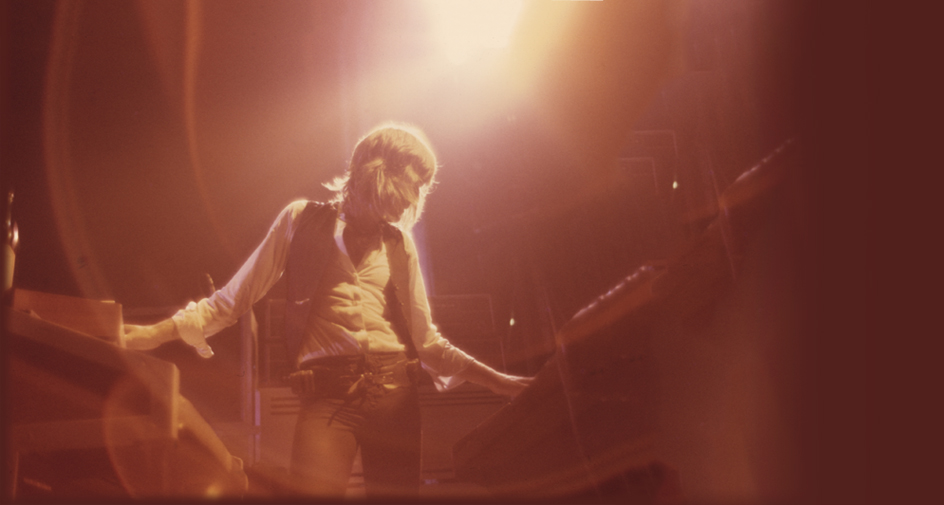
Mark's beautiful photo of Emerson in trance between the two keyboard rigs, the 1974 Brain Salad Surgery Tour.
_______________________________________________________________________________________________________________
The donated collection of Greg and Mark Hoffman certainly has interest for most Moog/ELP fans, and it’s amazing that new materials are still out there to be found. We’re excited to have their things for future use, as well, for lectures, books, Moogfest, and newsletters like this. The Hockmans made this for their own memories, their own history – and it is – but sharing it with us certainly brings all of us closer to “being there” as they were. MANY THANKS to Greg and Mark Hockman for sharing this collection with us!

From a much earlier era, on the Tarkus tour in late 1971; Keith with his (much smaller) original Moog synth and the rare Moog programmer on top.
CALL TO ACTION:
If you’re a longtime Moog fan and have something of interest to donate, the Bob Moog Foundation Archive can use whatever you have – old newpaper reviews, vintage Keyboard magazines, Moog catalogs, photos from shows or college music studios, photos of your Moog/synthesizer rig, music you’ve written. These things can help us tell the story – keeping people interested will all facets of the Moog music world. With your permission, we can use the materials to teach people about the evolution of Electronic Music, and how the Moog Legacy still affects the world today. Be creative – and add your own history to the Foundation’s growing collection. Contact us at info@moogfoundation.org.
Please help us keep Moog history alive for future generations. These photos and so much more from our archives will form the basis of our traveling exhibits and eventually our permanent exhibit at the future Moogseum. DONATE TODAY to help our preservation efforts.
Brian Kehew: Dec 1, 2010
Bob’s Archives on Exhibit at Museum Of Making Music
Waves of Inspiration Exhibit Opens with Celebration August 29th and 30th at NAMM Museum of Making Music in Carlsbad, CA
Keith Emerson and Erik Norlander Provide Musical Tribute
Larry Fast and Brian Kehew Offer Historical and Technical Perspective
Next Saturday the Museum of Making Music, in partnership with the Bob Moog Foundation, launches a special exhibition on the work, impact and collaborations of synthesizer pioneer Bob Moog. The exhibit, Waves of Inspiration. The Legacy of Moog. marks the first of its kind, as hundreds of items from the inventor’s extensive archive will be on display alongside vintage instruments, equipment and memorabilia from other institutions and collectors.
The exhibit highlights themes of musician/toolmaker collaboration, motivations and the innovative spirit, technological evolution through the medium of synthesis and music and creativity as forms of self-expression. Prototype and early instruments will also provide exhibit highlights as many rare instruments will be displayed together for the first time, including:
- modular protoype designed in 1964, formerly belonging to Herb Deutsch
- breadboard prototype of the Eaton-Moog Multi-Touch Sensitive Keyboard
- Serial #001 of the Crumar Spirit
- prototype of Minimoog Voyager
The exhibit will feature over 250 items from Moog’s archive alone.
The weekend will be marked with events that celebrate the Moog Legacy. On Saturday night, August 29, 2009, the museum will host the public opening of the exhibit with an evening reception followed by a musical celebration by synthesizer virtuosos Keith Emerson and Erik Norlander. Keith Emerson will be demonstration his infamous Monster Moog modular and talking about his time with the instrument over the past 30 years. Erik Norlander will be performing a special set on three Moog synthesizers: the Minimoog Model D, the Memorymoog Plus (on loan from Bob’s archive) and the Minimoog Voyager along with a selection of his favorite moogerfooger pedals.
On Sunday, pioneering synthesist Larry Fast and Moog historian and exhibit advisor Brian Kehew will share their expertise about the evolution of Moog instruments and trace their use in live performance. They will also talk about the the wider world of synthesis and its implications to past, current and future music.
The Bob Moog Foundation is proud to have Bob’s archive on display for public viewing and has thoroughly enjoyed working with the very capable staff at the Museum of Making Music. This meaningful exhibit is part of fulfilling our mission to educate and inspire people through electronic music, and is a precursor to constructing a Moogseum in Asheville, NC.