Seva Reports on Transferring the “Abominatron” Tape
Introduction: Seva David Ball is the the preservationist for the restoration of 40 reel-to-reel tapes in Bob’s archives, a project which is generously funded by two grants from the GRAMMY Foundation. Seva is an audio engineer whose accomplishments include serving as associate founder of Waves, mastering Dolly Parton’s only live DVD, and being the preservationist on David Lewiston’s archives of over 650 tapes for the Library of Congress. He is the owner of Soundcurrent Mastering in Knoxville,TN.

The tapes in the Bob’s archive span the years of 1964-1983, with work by pioneering synthesists such as Herb Deutsch, JonWeiss, Chris Swanson, Emmanuel Ghent, Wendy Carlos, Isao Tomita, Roger Powell, Joel Chadabe, John Eaton, William Hoskins, LaMonte Young and many more. Perhaps no tape in the collection is more seminal than the tape that Herb Deutsch donated to the Bob Moog Foundation in August. This 84 minute recording, which we here at the Bob Moog Foundation affectionately refer to as the “Abominatron” (as that is how Bob refers to the prototype modular), was recorded in 1964 in preparation for sending the prototype to experimental jazz musician Herb Deutsch. Herb, a professor of music (then and now!) at Hofstra University, collaborated with Bob for a year prior, giving him ideas, direction and input on a new instrument that they would call the “Electronic Music Composition System” — later to become known as the Moog synthesizer.
In the summer of 1964, Herb spent three weeks working side by side with Bob in his basement workshop in Trumansburg, New York, where Bob lived and was ran R.A. Moog, Co. Herb was to be Bob’s first musician-muse, and that first instrument was built largely to Herb’s specifications. Bob spent a couple of months perfecting the prototype and in the fall of 1964, prepared it to send to Herb. Along with the instrument, Bob sent a tape thoroughly explaining the various controls, perameters and capabilities of the instrument.
It is with deepest gratitude that we thank Herb for sharing the tape with us, and for allowing us to share it with you. By the end of 2010, we hope to produce a CD of the tape to share with all of you. We will be working on that project in the coming months.
From Seva:
This tape is logged as number 000, as it is really the very first chronological tape in the collection, and computer people (myself) start counting with zero! There’s another practical reason here: I’d already begun assigning tape numbers when Herb Deutsch graciously made this tape available to the Bob Moog Foundation, and since it is directly related to the pre-history of the commercial modular synth, I assigned it catalog number 000.
To set a frame of reference: I played my first Moog synthesizer at the age of 12 in 1970. It was a huge IIIp with dual sequencer complement at Florida State University (John Boda was the primary guy there) and I learned that the Moog was essentially a monophonic instrument (one note at a time). Last month I listened to the tape that Bob Moog made in 1964 as an audio letter to accompany his prototype synthesizer, which was being sent to Herb Deutsch. I was slack-jawed when I listened to the tape as Bob explained about the controls on the prototype device, and then played polyphonic sounds on this modular Moog synthesizer! This was 1964! I really couldn’t believe it, that this early prototype for the modular synthesizer was actually polyphonic. To my knowledge, this has not been revealed in any historical book on electronic music, the development of the modular synthesizer, or even as an anecdotal story told by those who were there. Absolutely amazing!
Listening to Bob talk about the controls on the prototype modular gave me a very clear insight on exactly how precedent is set. Bob would talk about the Range control, the Voltage control patch, the octaves as 8′, 4′, 2′, etc.: terms which are used on synthesizers to this very day, on Moog synthesizers made in this very year of 2009, and they have not changed. Therefore the precedent was set, the die was cast, the inventor was giving names to the controls that would echo through almost every single synthesizer made from that point forward. It simply blew my mind. Plus the recording had real-life stuff showing up in the middle of it, such as telling Herb to “call after 9 PM because the rates were low”. Ah yes, the days when the Bell System was still intact!
There’s much more to this tape, including what is probably the first two part invention ever recorded on a Moog synthesizer. And that, without overdubs. In the middle of the tape, a click indicated Bob had turned off the recorder; when it bumped back on, he said “something remarkable had just happened”, that he was “going to have a booth at the AES” (in 1964), and that he only had 4 weeks to get ready!
This is just part one of blogging about this tape; don’t fret, I’ll post at least one entry about this very remarkable audio document. Since I played my first Moog at 12, I hope you get that I’m seriously thrilled about this adventure into Bob’s tapes and ask everyone to chip in to help fund the Foundation’s important work, i.e., make a contribution. More soon!
Thank you. (And happy Thanksgiving!)
This Thanksgiving, The Bob Moog Foundation is thankful for you.
Happy Holidays!
I’m Sean McDonald, one of the board members of the Bob Moog Foundation. Like most people, my attention is turning from my job and day-to-day life, to focus on the things that matter most–the things that make my life rich, meaningful and happy.
The past year has been a great year for the BMF. We have had some huge accomplishments. I want to take the time to highlight a few and express my thanks for all of your support.
First and foremost, the BMF has been blessed to work with our incredible Executive Director, Michelle Moog-Koussa. Most people know Michelle–or “Mimi” to some of you–as Bob’s daughter. But it’s important to understand that Michelle is a talented, tireless and deeply committed individual who has built this foundation from the ground up. Her leadership and determination are among the things I am most grateful for this Thanksgiving.
We launched our effort to build the Moogseum and received a commitment from the Buncombe County (Asheville, NC) Tourism Development Authority for 20% of our total goal. (That’s $600,000 out of $3,000,000 FYI.) That is a great start to building one of the world’s most innovative community engagement and artistic development spaces.
Additional thanks go to the Grammy Foundation, Moog Music–who just donated a Moog Guitar signed by Lou Reed, which will be auctioned off Dec 7th as a benefit to the BMF–and all our donors and other funding partners.
We also hosted our first Bob Moog exhibit with our partner, the Museum of Making Music in Carlsbad, CA. If you are in Southern California anytime soon (think: NAMM 2010), make sure to visit the space.
We released a new version of MoogFoundation.org, and I am eternally thankful for our Web Development team, one of the many groups of our “Rockstar Volunteers.” (There are too many to thank individually, but we love you all!) In addition, we held several MoogedOut events with the support of actual rockstars, like Umphree‘s McGee and Toubab Krewe.
Most important, and I can say this on behalf of the whole Board of Directors, we are thankful for you: our friends, partners and allies. For your gifts of time, talent and treasure to the BMF. For your creativity and enthusiasm. And for your commitment to our work, fostering innovation at the intersection of science and music.
If you would like to give some time, talent or treasure, email me and we’ll talk directly about how you can help. (If you are interested, we’re accepting applications for board members.)
I hope you and yours have a wonderful Thanksgiving. We’ll be in touch soon.
Sincerely,
Preservation on Reel-to-Reel Tapes in Bob’s Archives Begins With Help of GRAMMY Foundation
Audio Preservationist Seva Ball Begins Transfer of Archive Tapes With Help of GRAMMY Foundation Funding.

Seva David Ball, setting a tape for transfer
In March of 2008, the Bob Moog Foundation was awarded an $8,000 assessment grant from the GRAMMY Foundation to assess the physical, historical, and legal viability of over 300 reel-to-reel tapes in Bob’s archives. After months of study, three experts verified and prioritized 143 tapes to cleaned and transferred.
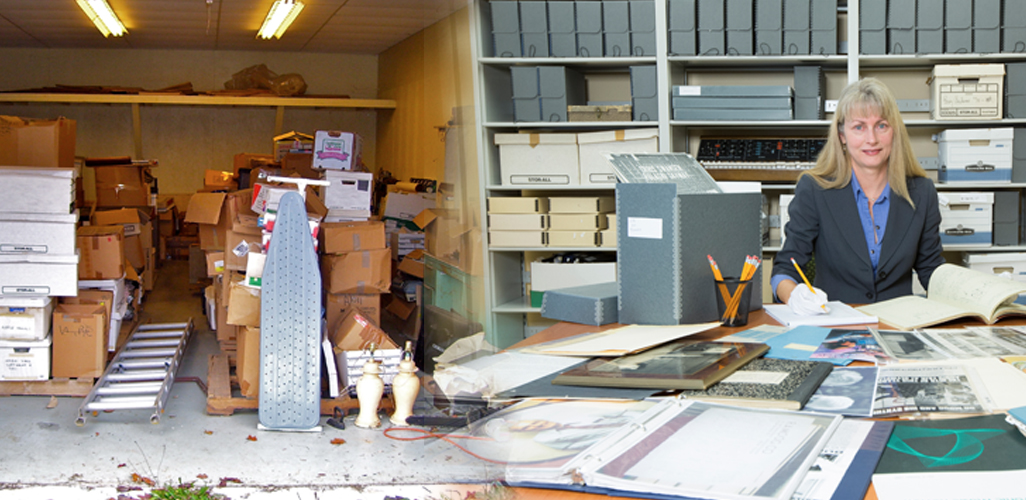
In the summer of 2009, the Foundation was awarded a $15,000 preservation grant from the GRAMMY Foundation to begin work on the prioritized tapes. Many of the tapes have been compromised by previous unstable storage conditions and the wear and tear of time; they will need mold remediation, baking, rewinding and re-housing on new reeels before they are ready to be transferred to digital format. Audio engineer and preservationist Seva David Ball of Soundcurrent Mastering is heading the team who will complete the process on over 40 of the tapes.
Prioritized tapes include those of Roger Powell (Utopia), Chris Swanson (House composer for R.A. Moog, Co.), Harolde Bode (speaking about he Bode Frequency Shifter), Emmanuel Ghent, Sun Ra, William Hoskins and Bob himself (speaking at a variety of seminars around the birth of the prototype). Recently a very special donation was made to this collection from an early synthesizer pioneer– we’ll be telling you about it and sharing it with you next month.
The project is expected to take 6 months to complete.
Many thanks to the GRAMMY Foundation for their ongoing support! This project would not have been possible without them!