

Posts Tagged ‘bob’s archives’

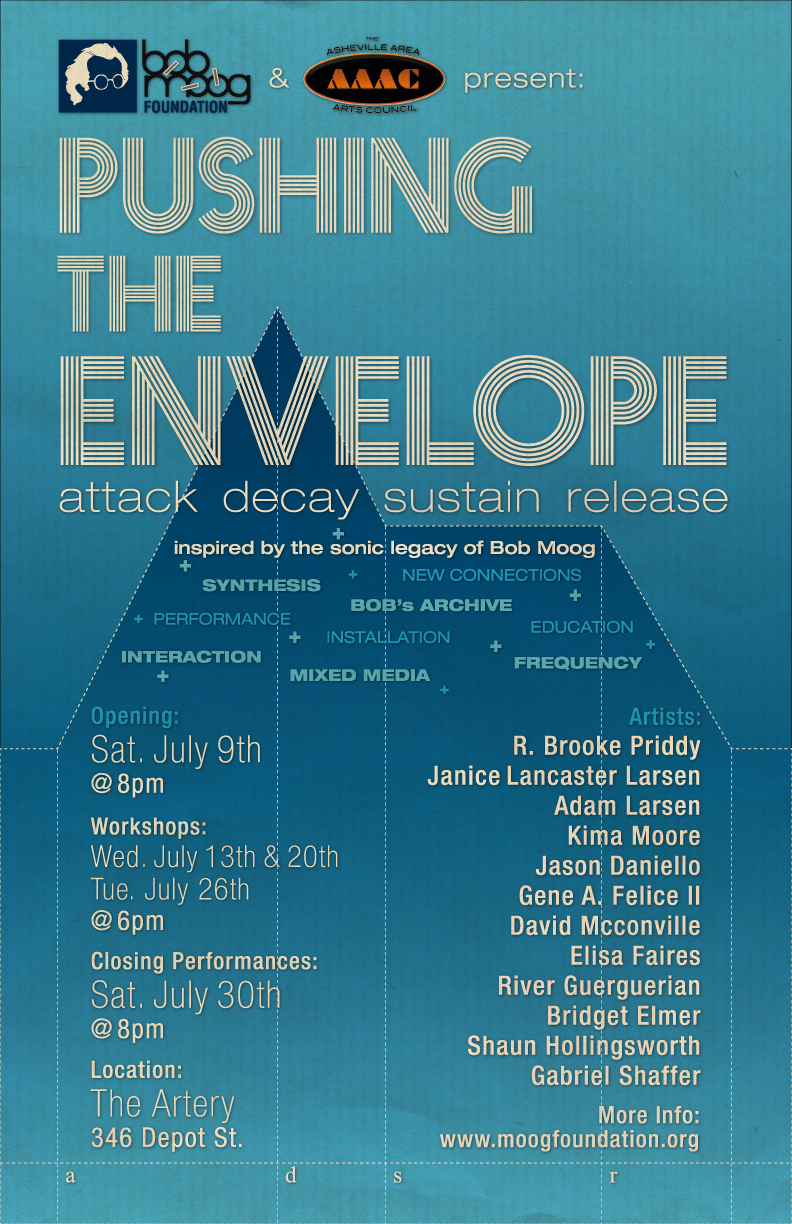
Pushing the Envelope: Attack, Decay, Sustain, Release

Please join us for our closing reception this Saturday, July 30th at 8 p.m.

Help us release Pushing the Envelope at its final event of the month-long exhibit at the Artery. Dancer Janice Lancaster Larsen will perform in R. Brooke Priddy’s earthen dress that captivated so many of you at the opening event.

Join us for an evening of music and dance, while reflecting on the pieces inspired by Bob Moog’s sonic legacy.


Public Opening Reception: Saturday, July 9th at 8 p.m.

Workshops (All Ages):

Wed. July 13th
Bridget Elmer at 6 p.m.

Wed. July 20th
Chris Stack & Steve Wager at 6 p.m.

Tue. July 26th
River Guerguerian & Gene Felice at 6 p.m.

Closing Evening of Performances: Saturday, July 30th at 8 p.m.


Artery Hours: 11 a.m. until 6 p.m. Tuesday through Saturday


Pushing the Envelope: ADSR is a forthcoming multimedia art show melding the historical roots of electronic music with the creativity of Asheville artists who have been inspired by the connections between analog synthesis and visual and performing arts. Bob Moog’s pioneering work will serve as inspiration for the exhibit. The show will be held at The Artery in Asheville’s River Arts District from Saturday, July 9, through Saturday, July 30. The Asheville Area Arts Council and the Bob Moog Foundation are cosponsoring the three-week exhibit.

Artists involved in the show will interpret the concept of shaping sound through an “envelope,” drawing inspiration from the synthesizer parameters attack, decay, sustain, and release. Pushing the Envelope‘s participating artists are:

R. Brooke Priddy, Janice Lancaster Larsen, Adam Larsen, and Kima Moore — A  fashion/movement/installation/sound collaboration

Jason Daniello – Exploring interactive, analog sound

Gene A. Felice II & David McConville – An interactive, cymatics/analog sound collaboration that will allow viewers to visualize sound waves.

Elisa Faires – Sound performance/installation

River GuerguerianVirtuoso percussionist presents sound performance and workshop

Bridget Elmer – An analog sound-inspired letterpress print series

Shaun Hollingsworth – A Bob Moog Foundation photo print series exploring vintage circuitry

Gabriel Shaffer – This sculptural theremin exhibit will allow attendees to interact with metal art, light and analog sound

The work of these artists will surround a small selection of analog electronic instruments, schematics, notes, and ephemera from Bob Moog’s archives, illustrating the connection between innovation, electronic sound, and creativity in the arts. A focal point of the show, the archives will illustrate both the history and the technology behind the Moog sound. This includes the envelope generator, a major component in music synthesis that controls changes in a sound’s loudness and spectral content over time. Most envelope generators control four parameters—attack, decay, sustain, and release—commonly referred to as simply ADSR.

In addition, the show will give the Asheville Area Arts Council and the Bob Moog Foundation opportunities to highlight their respective missions and pay homage to art, music, and technology as intertwined mediums of expression that were all expressed in Bob Moog’s work.

There will also be a series of all-ages workshops focused on the show’s theme and on community outreach and education. Participants will have opportunities to learn about electronic synthesis, sound visualization, and art in a hands-on environment.

Workshop Schedule and Descriptions

All Pushing the Envelope workshops have a suggested donation of $5 to attend.
Workshops all start at 6pm and run approximately 90 minutes.

Bridget Elmer – July 13

This workshop will explore sound visualization through the processes of printing and bookmaking. Each participant will experiment with translating sounds into hand printed images and transforming their prints into a variety of book forms. No experience necessary.  There is a materials fee of $5 per person.

Steve Wager and Chris Stack – July 20

We Have Fallen Into The Place Where Everything Is Music

Don’t worry about writing down these songs!
And if one of our instruments breaks, it doesn’t matter.
We have fallen into the place where everything is music.
~Rumi

Ever wanted to know what was happening in a synth that creates those amazing noises? What is the difference between analog and digital (and why do some people think analog is better?) Steve Wager, long time BMF Volunteer and synthesizer enthusiast,  will explain the foundation of electronic music in easy to understand terms utilizing the Bob Moog Foundation’s new educational synth, the Novitiate. Participants will then have the opportunity to expand upon their new knowledge with a workshop by Chris Stack of ExperimentalSynth.com fame. Chris will explore the basics of experimental patches and sound design and will treat attendees with a short performance.

Chris explains “It’s an amazing time to be a musician. We can now make music on everything from traditional instruments, computers and synths to tablets and even cell phones. In this workshop, I will weave all this together and explains the connections and technologies that make it possible”.

Gene Felice and River Guerguerian – July 26

Gene Felice is a rock star multi media artist. River Guerguerian is an internationally acclaimed virtuoso percussionist. The have teamed up in this unique workshop to explore the elements of sound, frequency & matter, via a timeline of ancient to contemporary sources of analog sound (singing bowls, gongs, theremin, water & sand) with participants.  Through cymatics they will illustrate both sides of how matter affects sound, and how sound affects matter.

“We are delighted to be collaborating with a breadth of Asheville’s talented artists. Inspiring creativity, be it sonic, visual, technical, or intellectual, is at the heart of the Foundation’s work. It’s very exciting to see Bob Moog’s work come alive through the exceptional talent that exists in our unique city.”

– Michelle Moog-Koussa, Bob Moog Foundation’s Executive Director


Through the various forms of synthesis, we control the spectral content of sound and image as it changes over time. Through the modes of attack, decay, sustain, and release, we influence the sonic character of our work. The ADSR envelope will control the amplitude and frequency of creation. From nil to peak, subsequent rundown, the key is released, leveling to zero.”

– Gene Felice, Collaborating Artist & Curator for the show


“The legacy of Bob Moog and his impact on the creative community here truly cannot be overstated. We’re honored, not only to have the opportunity to pay tribute, but also to engage several of the area’s most vital emerging artists who continue to build upon Moog’s ingenuity.”

– Graham Hackett, Interim Executive Director of the Asheville Area Arts Council


Share

From Bob Moog’s Private Archives: highlights and signing in NYC

An exciting package arrived from France at the Bob Moog Foundation headquarters last week. In it contained our very own Dr. Bob’s Collector Pack from Arturia containing a gorgeous book, From Bob Moog’s Private Archives. The collector pack also contains software versions of the Minimoog and Moog Modular synths, a DVD copy of the Moog documentary, and a special edition Bob Moog Foundation badge.


From Bob Moog’s Private Archives, which is only available with purchase of the collector pack, contains 70 full color pages with images from Bob’s archives and text by Michelle Moog-Koussa. Items featured from the archives are photographs, vintage advertisements from R.A. Moog and Moog Inc, letters, and even hand drawn schematics.


To celebrate the release of Dr. Bob’s Collector Pack Michelle will be doing two appearances and book signings in New York City at the end of the month. At these events you will be able to meet Michelle and learn about the variety of ways that you can help the Bob Moog Foundation as they preserve and protect Bob’s archives and develop science and music education programs. Copies of Dr. Bob’s Collector Pack will be available for purchase so you can have Michelle sign your copy of the book, or just stop by and say hi. No purchase is necessary to attend the signing.

We hope to see you there!


Thursday June 30th, 5pm-8pm
Guitar Center Manhattan
25 W 14th Street, New York, NY 10001
Phone: 212-463-7500 
View Larger Map

Saturday July 2nd, 10am-1pm
Sam Ash New York
156 W 48th Street, New York, NY 10036
Phone: 212-719-2625
View Larger Map


Share

Seva Explores the Abominatron Tape, part 2


Seva David Ball is the the preservationist for the restoration of 40 reel-to-reel tapes in Bob’s archives, a project which is generously funded by two grants from the GRAMMY Foundation. Seva is an audio engineer whose accomplishments include serving as associate founder of Waves, mastering Dolly Parton’s only live DVD, and being the preservationist on David Lewiston’s archives of over 650 tapes for the Library of Congress. He is the owner of Soundcurrent Mastering in Knoxville,TN. As he restores the tapes, Seva will be blogging a bit about each one, and including sound samples.


While the GRAMMY Foundation provides generous funding, they do not cover all of the costs associated with the extensive project. If you are inspired by historical material that we are preserving, please consider making a donation to the Foundation to help us continue our efforts.


In this blog post, Seva explores a tape that was donated to us by pioneering synthesist Herb Deutsch, who collaborated with Bob on the first prototype modular. In this 84 minute tape, Bob methodically explains the functions of the modular. We are excited to include five snippets of that tape here. Many thanks to Herb Deutsch for this historical treasure.


Abominatron Tape Transfer, Part 2

Seva David Ball


As alluded to in my first entry, when Dr. Moog was working on the prototype modular synthesizer in the early sixties, he had set in motion a very large number of design parameters, terminologies, and infrastructures. Things such as using ‘feet’ as designation for which pitch range within the oscillator would work, just as in pipe organs, i.e. 32′, 16′, 8′, 4′, 2′, 1′, all measured in feet to indicate the base length of the pipe in that rank. A pipe half the length of another gives a tone one octave higher (and twice the frequency, being inversely proportioned). Another example now in widespread use is “Voltage Control”, which was probably the most impressive part of the vocabulary to me (when I learned of it, I was 12) because it literally took the place of my hand turning a knob. Even with my limited understanding, this principle of voltage control was a cloudless sky for me; it unlocked the entire potential. The synthesizer had three main components: Sources, Controllers, and Modifiers, and voltage control made it all work.


On this tape, Bob explains that the voltages add together to control the oscillator, plus an internal voltage (selected by the Pitch Range switch=32, 16, 8, 4, etc) adds or subtracts eight-tenths of a volt, shifting the pitch up or down one octave. (Eventually there was a standard of 1volt/1octave but I will not pretend to know the precise evolution of this standard). He gives several examples of using low frequency oscillators (LFO) to provide (musical) vibrato and other forms of exotic vibrato (Frequency Modulation can yield classic space sounds or really new klang with mirrored sum-and-difference tones).


Voltage Control had already been part of Bob’s breadboard projects and his 1964 prototype. It was only a matter of months before others requested new ways for Voltage Control to be utilized. Vladimir Ussachevsky asked for a device to create an attack-decay-sustain-release voltage (ADSR) which was used to control an amplifier (VCA) so that pressing a note would create a tone with dynamic shaping. Gustav Ciamaga ordered a voltage controlled filter (VCF) in 1965, and this created the tone shaping everyone refers to as that Moog Sound (especially with Bob’s 4-pole filter design).


Bob took piano for many years as a young person, and could readily play, although he was very modest about his ability. He made a nearly innocent statement that others with more musicianship could get “some good things” out of the instrument, and I included a clip of this sincerely prophetic statement.

Better Musicianship:

Audio clip: Adobe Flash Player (version 9 or above) is required to play this audio clip. Download the latest version here. You also need to have JavaScript enabled in your browser.


In this proto-incarnation of the modular synthesizer — the Abominatron, as Bob called it — there were two VC devices: oscillators and amplifiers. (There’s a clip where he Gives It The Name, at least on tape). The astonishing part of all this to me remains the fact that this first modular synthesizer, this Abominatron, was POLYPHONIC. I’ve attached some audio clips from this tape, including the Intro Fanfare, where Bob plays a polyphonic greeting before he speaks, followed by a clip where Bob names the prototype.

Polyphonic Fanfare:


Audio clip: Adobe Flash Player (version 9 or above) is required to play this audio clip. Download the latest version here. You also need to have JavaScript enabled in your browser.

Abominatron


Audio clip: Adobe Flash Player (version 9 or above) is required to play this audio clip. Download the latest version here. You also need to have JavaScript enabled in your browser.


Another polyphonic section is when he first demonstrated voltage control for simple vibrato, but he plays a polyphonic example, “As I Walked Out in the Streets of Laredo”, in a two-part invention style, quite removed from Marty Robbin’s 1959 dreamy single. To my knowledge this song (and the Intro Fanfare) is the first recording of a polyphonic modular synthesizer. It is so beautiful that the inventor of the instrument is also a musician, and one who could play at the drop of a hat, and that we have this document, this recording, of Dr. Moog doing exactly that.

Modulate and Polyphonic:

Audio clip: Adobe Flash Player (version 9 or above) is required to play this audio clip. Download the latest version here. You also need to have JavaScript enabled in your browser.

A great thing about “audio letters” is you can stop recording any time and continue when convenient. Most of the time a click or pop signifies such a break, and in one such place Bob says “it’s 2 days later now” since his previous recording, and he reveals the spectacular news that Jacqueline Harvey of the AES (Audio Engineering Society) had called to invite him to have a booth at the October 1964 AES meeting in the Commercial Exhibits area (which at that time was hardly the large tradeshow floor familiar today; the main purpose of the meeting was for presentation of papers and so forth). There’s an audio clip where he reveals this news to Herb Deutsch, and went on to say that it was a “tremendous opportunity for me to get this going, sooner than I thought”, but he also recognized being at the AES show had the potential for him to makethat it was also a “an a– of myself”. That didn’t happen. The opportunity for success immediately began to realize itself. Clearly, we all know he succeeded beyond his expectations and would initiate a paradigm shift in the use of electronics in music as instruments.

AES Invite:

Audio clip: Adobe Flash Player (version 9 or above) is required to play this audio clip. Download the latest version here. You also need to have JavaScript enabled in your browser.


Share

Roger Powell (keys Utopia, David Bowie) remembers Bob

Roger Powell, former keyboardist for Utopia and David Bowie tells us of Bob Moog’s importance in his career. Roger speaks out about the Bob Moog Foundation, and the effort to preserve Bob’s archives. Thanks Roger!!

Share